

The latest industries and services news from Kentucky
Provided by AGP
Coder Sets a New Standard for AI Coding with Self-Hosted, AI Model Agnostic Coder Agents
New native agent architecture enables enterprises to run AI-driven development workflows with full governance over infrastructure, data, and models
AUSTIN, Texas, May 06, 2026 (GLOBE NEWSWIRE) -- Coder, the leader in self-hosted AI development infrastructure for the enterprise, today announced the beta release of Coder Agents. The solution is a native AI coding agent designed to run entirely on self-hosted infrastructure and empower developers to use any AI model they desire, giving enterprises the security and governance required to run AI-driven development workflows at scale.
AI adoption in software development has accelerated rapidly, with 61% of engineering teams already running agents. Yet most remain in early stages of maturity and lack the infrastructure to scale them safely. Many rely on tools with cloud-hosted orchestration, sending code and context to third-party services with limited visibility or control. For large enterprises and companies in highly regulated industries, this tradeoff is unacceptable.
Built directly into Coder, Coder Agents gives enterprises a way to deliver modern, agent-driven developer workflows without sending source code, prompts, or model interactions outside their network perimeter. Instead of running agents in a vendor-controlled cloud, the entire agent system — including the control plane, orchestration, and execution — runs on infrastructure owned and operated by the customer, enabling centralized governance and secure, scalable development across the organization.
“Companies are being forced to choose between adopting AI agents and maintaining control over their infrastructure and data,” said Rob Whiteley, CEO at Coder. “Coder Agents removes that tradeoff. You get a modern, conversational agent experience, entirely inside your own environment. Now enterprises can equip any employee with any AI coding model of their choosing, with the governance and flexibility they require.”
The standard for AI coding workflows
AI coding workflows are entering a new phase. As model capabilities continue to advance, differentiation is shifting away from the agent itself and toward the infrastructure required to run it securely and at scale. Despite this demand, Coder research shows that 70% of companies are deploying agents on infrastructure that was never designed to support them, exposing a gap between adoption and enterprise readiness.
Coder addresses this challenge, enabling organizations to:
- Keep source code, prompts, and model traffic within the network boundary
- Run agents in fully air-gapped or network-restricted environments
- Connect to any AI model provider or self-host AI models entirely without intermediary routing
- Enforce centralized policies for model access, prompts, and usage across teams
For platform teams, Coder Agents provides a standardized way to deploy and manage AI agents across the organization. Instead of fragmented tooling and inconsistent configurations, teams can centralize model access, enforce policies, and gain visibility into how agents are used and what they produce. Developers can delegate tasks such as writing code, generating tests, analyzing repositories, and opening pull requests through a conversational interface and API.
Coder Agents is available now in beta, with full feature access and no usage-based limits through September. For more information, visit the website.
About Coder
Coder is the only AI development Infrastructure that unifies development environments, AI governance, and autonomous agents into a single, self-hosted system. It enables enterprises to move development off unmanaged endpoints and into standardized, policy-controlled environments where both builders and AI agents operate in parallel safely. With centralized governance, AI model-agnostic flexibility, and full observability, Coder allows organizations to scale AI adoption without compromising security, compliance, or cost control. Learn more at coder.com.
Media Contact
Jennifer Tanner
Look Left Marketing
coder@lookleftmarketing.com
Coder Agents Frequently Asked Questions
Q: What is Coder Agents?
A: Coder Agents is a native AI coding agent that runs on self-hosted infrastructure. The agent operates from the Coder control plane and provisions workspaces only when code execution is required, allowing developers to complete tasks like writing code, generating tests, and opening pull requests without sending source code or prompts outside their environment.
Q: How is Coder Agents different?
A: Most AI coding agents rely on cloud-hosted orchestration, where parts of the agent workflow (planning, inference, or coordination) run on vendor infrastructure. Coder Agents runs the entire agent system, including the control plane, orchestration, and execution, on infrastructure owned by the customer. This allows organizations to maintain full control over data flow, enforce governance policies, support air-gapped environments, and choose any model provider without intermediary routing.
Q: How is Coder Agents different from tools like Claude Code, Codex, or Cursor Agents?
A: Coder Agents is not a wrapper around tools like Claude Code or Codex. It uses its own native agent and runs entirely on customer-controlled infrastructure. Unlike many AI coding tools that rely on cloud-hosted orchestration, Coder Agents keeps the full agent system (planning, orchestration, and execution) inside the customer’s environment. This provides greater control over data, governance, and model usage.
Q: Why do enterprises need self-hosted AI coding agents?
A: Enterprises, especially in regulated industries, need to control where source code and model interactions are processed. Many existing AI coding tools require sending code and context to third-party cloud services, which creates challenges around data residency, compliance, and auditability. Self-hosted agents allow organizations to adopt AI-driven development while keeping all activity within their own infrastructure, ensuring security, governance, and visibility.
Q: Does Coder Agents lock teams into a specific AI model?
A: No. Coder Agents is model-agnostic and supports multiple providers, including Anthropic, OpenAI, Google, AWS Bedrock, and self-hosted models. Platform teams can centrally control which models are available, and developers can use approved options without being locked into a single vendor.
Q: Can Coder Agents run in air-gapped or regulated environments?
A: Yes. Coder Agents is designed to run entirely on self-hosted infrastructure, including cloud VPCs, on-prem environments, and fully air-gapped deployments. Organizations can also connect to self-hosted models, ensuring that no code, prompts, or model traffic leaves their network. This makes it suitable for industries with strict security, compliance, or data residency requirements.
A photo accompanying this announcement is available at https://www.globenewswire.com/NewsRoom/AttachmentNg/9763cea9-04a6-41ed-90c7-18be5b4aa5ae


Coder Sets a New Standard for AI Coding
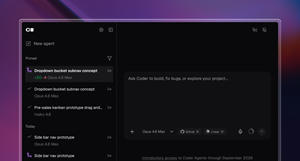
Coder today announced the beta release of Coder Agents.
Legal Disclaimer:
EIN Presswire provides this news content "as is" without warranty of any kind. We do not accept any responsibility or liability for the accuracy, content, images, videos, licenses, completeness, legality, or reliability of the information contained in this article. If you have any complaints or copyright issues related to this article, kindly contact the author above.
